AI Transformation is a Problem of Governance
85% of AI projects fail — not because the models are wrong, but because organizations were never built to govern them. We cover the structural oversight frameworks that separate winning AI programs from failed ones.
What Is AI Governance — and Why Does It Matter in 2026?
AI governance is the complete set of policies, accountability structures, technical controls, and cultural practices that determine how AI systems are built, deployed, monitored, and corrected inside an organization. It is not a compliance checkbox. It is the operating system for responsible AI at scale.
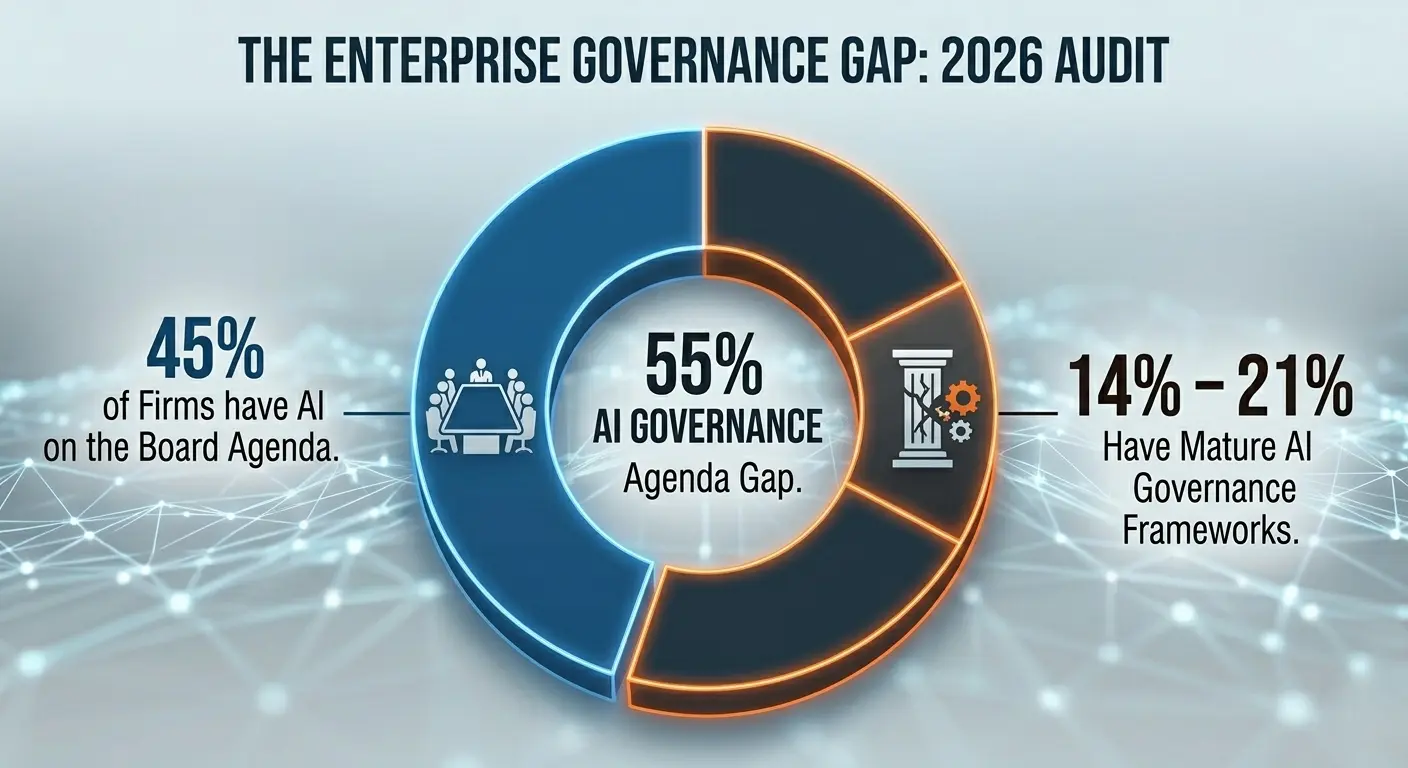
In 2026, most enterprises have adopted AI. Only one in five has a governance model mature enough to manage it. That gap — between rapid adoption and missing oversight — is where projects fail, executives lose jobs, and regulators intervene.
The organizations succeeding with AI are not those with the best models. They are the ones that built governance architecture first: clear ownership, escalation paths with real authority, continuous bias monitoring, and decision provenance that can survive a board audit.
The August 2, 2026 EU AI Act deadline makes this urgent. For high-risk AI systems, conformity assessments, transparency obligations, and CE marking are now mandatory. The "we relied on our vendor" defense no longer holds. Accountability starts with the deploying organization.
The Three Pillars of AI Governance
Every functional AI governance framework in 2026 operates across three distinct layers. Organizations that treat any one as optional are building on an incomplete foundation.
Policy & Accountability
Every AI system needs a named human owner with escalation authority — not a committee, not a vendor. Without it, accountability diffuses until no one is responsible.
Technical Controls
Bias detection, drift monitoring, and explainability pipelines that run continuously in production — not just at model evaluation time.
Culture & Transparency
The most underestimated pillar. Thick governance policies create friction, friction drives shadow AI use, and shadow AI creates the exact risks governance was designed to prevent.
Latest Insights
Research-backed analysis of the 2026 AI governance landscape.



Written by a Researcher in AI Governance & Risk Analysis
This site is authored by Muhammad Hassan, a researcher focused on AI governance frameworks, transformation risk, and compliance architecture. Every article is grounded in primary sources — Gartner, RAND, IBM, NIST, and the EU AI Act — not generic summaries.
The goal is simple: provide the structural analysis that boards, CTOs, and compliance officers need to build AI programs that survive audits, scale beyond pilots, and deliver real ROI.
What you will find here
- Deep-dive analysis of the EU AI Act compliance requirements
- Case studies on executive accountability in AI governance failures
- Practical frameworks for building AI governance from scratch
- Research-backed breakdowns of agentic AI risk and controls
- The 30% Rule and other practical governance heuristics for 2026