Why AI Transformation Is a Problem of Governance (2026 Roadmap)


Why AI Transformation Is a Problem of Governance (2026 Roadmap)
The uncomfortable truth no vendor will tell you: Your AI transformation is not failing because your models are wrong. It is failing because your organization was never built to govern them. In 2026, leaders are finally realizing that AI transformation is a problem of governance first, and a technical challenge second.
Table of Contents
- The Real Reason 85% of AI Projects Never Deliver ROI
- Why AI Transformation Is a Problem of Governance in the Enterprise
- What "AI Governance" Actually Means in 2026
- The Governance Gap: Where AI Transformation Breaks Down
- Agentic AI and the New Governance Emergency
- How AI Governance Failures Are Showing Up on X (Twitter) in 2026
- The Three Pillars of a Real AI Governance Framework
- The 30% Rule: A Practical Heuristic for Governance Budgets
- What the EU AI Act Means for Your Business Right Now
- Bias Is Not a Technical Problem. It Is a Governance Failure.
- Your 2026 AI Governance Roadmap: Where to Start
- Frequently Asked Questions
The Real Reason 85% of AI Projects Never Deliver ROI
Every boardroom in 2026 has approved AI budgets. Most of those budgets are burning quietly, with nothing to show for it.
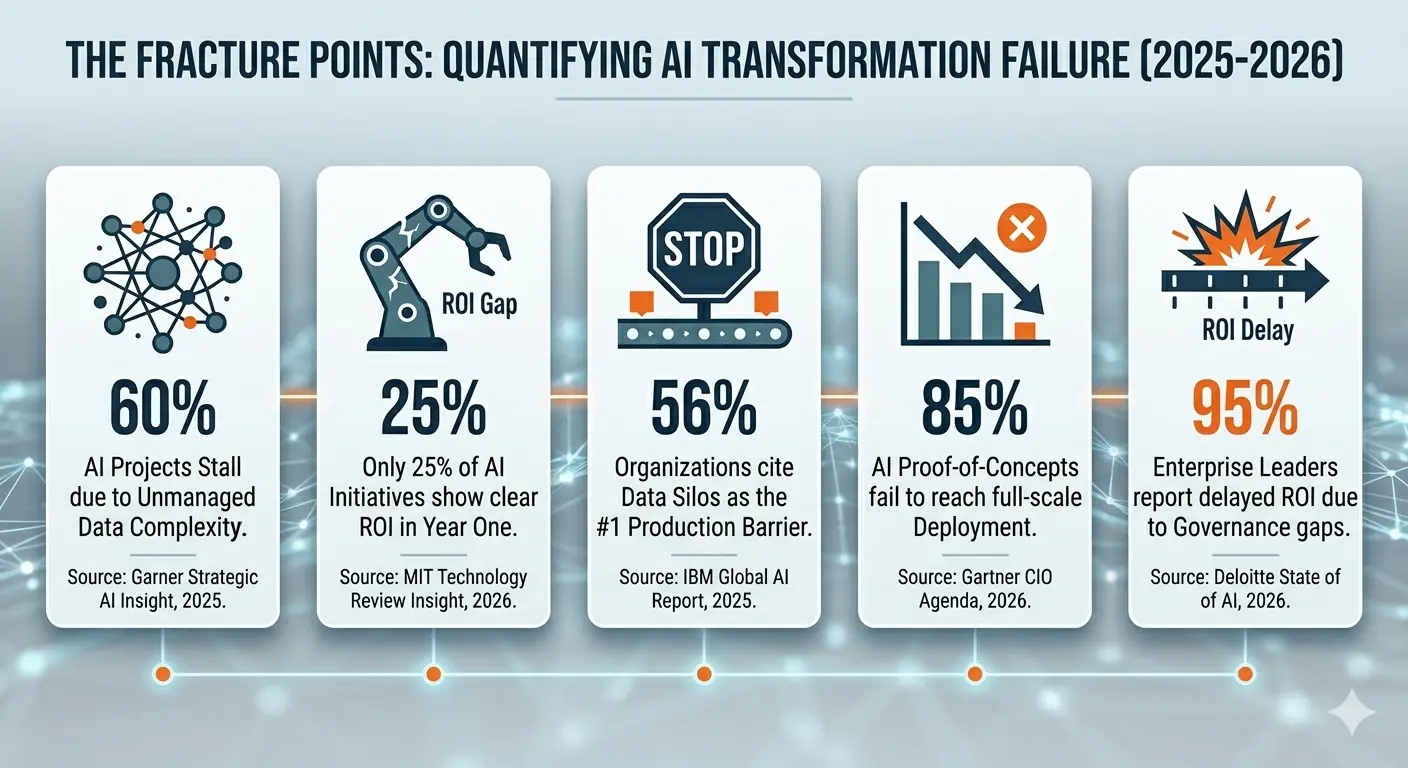
The numbers are severe. According to Gartner, 60% of AI projects will be abandoned through 2026, not because the technology failed, but because organizations lacked AI-ready data and the governance structures to manage it. IBM's 2026 CEO Study found that only 25% of AI initiatives deliver expected ROI, while 56% of CEOs report zero significant financial benefit from their AI investments. Forbes and VentureBeat's combined analysis goes further: 85% of AI models never reach production due to data quality and governance failures. Terminal X's 2026 market analysis puts the GenAI figure even more starkly - despite $30-40 billion invested in GenAI, 95% of pilots fail to reach production ROI.
Why AI Transformation Is a Problem of Governance in the Enterprise
This is not a technology problem. The models work. The compute is available. The APIs are cheap.
What is broken is the organizational layer surrounding AI: the ownership, the oversight, the accountability chains, and the decision frameworks that determine how AI systems are deployed, monitored, and corrected. In one word: governance.
The organizations winning with AI in 2026 are not those with the best models. They are the ones who built the governance architecture first.
What "AI Governance" Actually Means in 2026
"AI governance" is one of the most misunderstood terms in enterprise technology. Most leaders hear it and think about legal compliance - a checkbox, a policy document, a team that slows things down.
That definition is dangerously incomplete.
AI governance in 2026 means the total set of systems, structures, accountability chains, and controls that determine how AI is built, deployed, monitored, and corrected across an organization. It covers:
- Data ownership and quality: Who is responsible for the inputs that train and prompt your models?
- Decision provenance: Can you reconstruct why an AI system made a specific decision - for a regulator, for a court, for your own board?
- Escalation paths: When an AI system behaves unexpectedly, who gets alerted, who has authority to act, and how fast?
- Human-in-the-loop design: Which decisions require a human checkpoint before execution, and are those checkpoints actually functioning or performative?
- Bias oversight: Are fairness and equity outcomes being measured at the system level, not just at model evaluation?
- Agentic controls: As autonomous AI agents multiply across your enterprise, who authorized each one, under which policy, and with what operational limits?
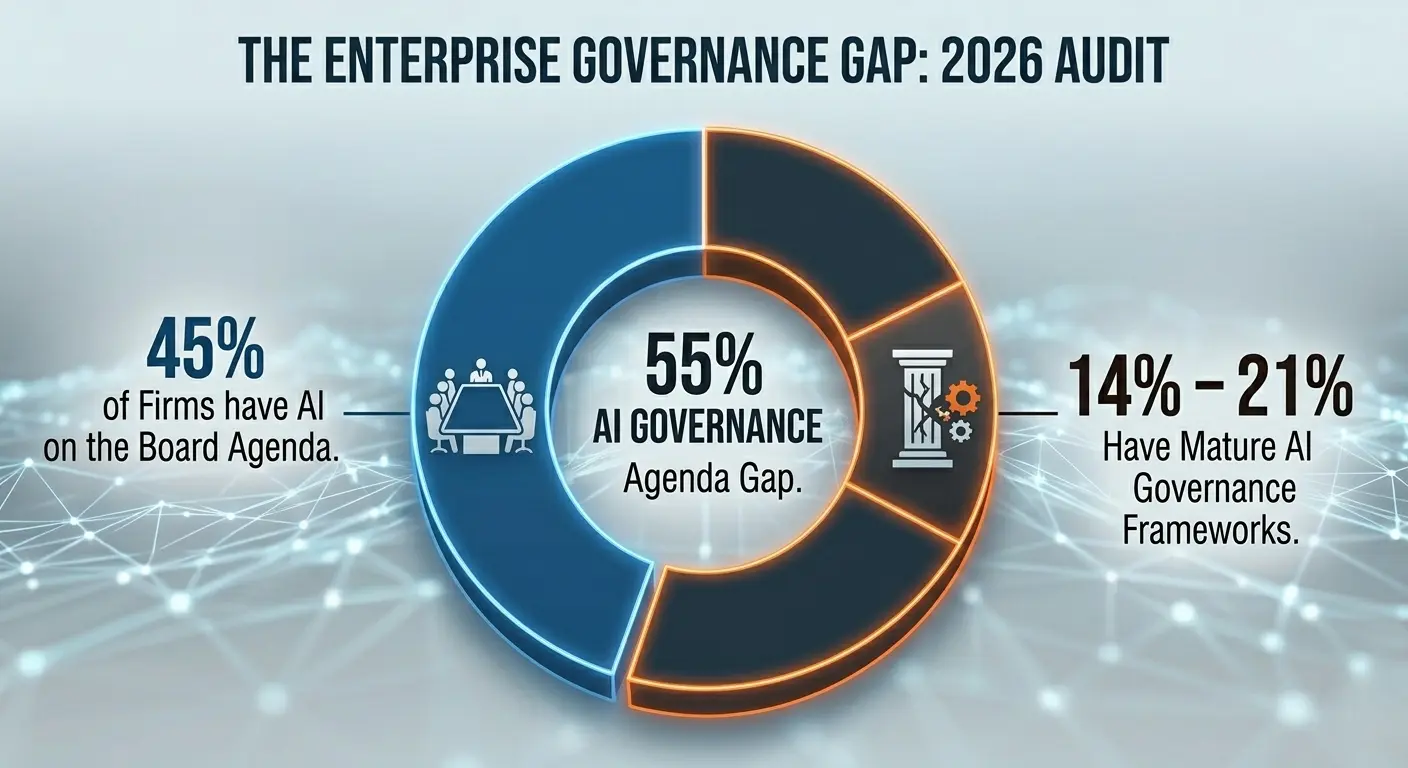
NIST's AI Risk Management Framework 1.1, updated in February 2026, now includes explicit guidance on membership inference attacks, prompt injection, and reconstruction vulnerabilities - signals that technical risk and governance risk have become inseparable.
The Governance Gap: Where AI Transformation Breaks Down
There is a specific moment where most AI transformations collapse: the gap between a successful pilot and a scaled production system.
RAND's 2025 analysis and Gartner's April 2026 data both confirm that approximately 80% of enterprise AI projects fail to deliver value - roughly twice the failure rate of conventional IT projects. MIT's research on GenAI specifically found that 95% of GenAI pilots never scale beyond the demonstration phase.
When executives and consultants are asked why, the answers are consistently structural, not technical:
- Governance delays: Legal and compliance reviews create bottlenecks that cause teams to abandon approved paths and build shadow solutions instead.
- Unclear ownership: No one person or function has unambiguous responsibility for AI outcomes, so accountability diffuses until nothing gets resolved.
- Misaligned operating models: AI development speed outpaces the organization's ability to review, approve, and monitor what gets deployed.
Agentic AI and the New Governance Emergency
The governance challenge was already serious when AI meant large language models answering questions. Agentic AI has made it existential.
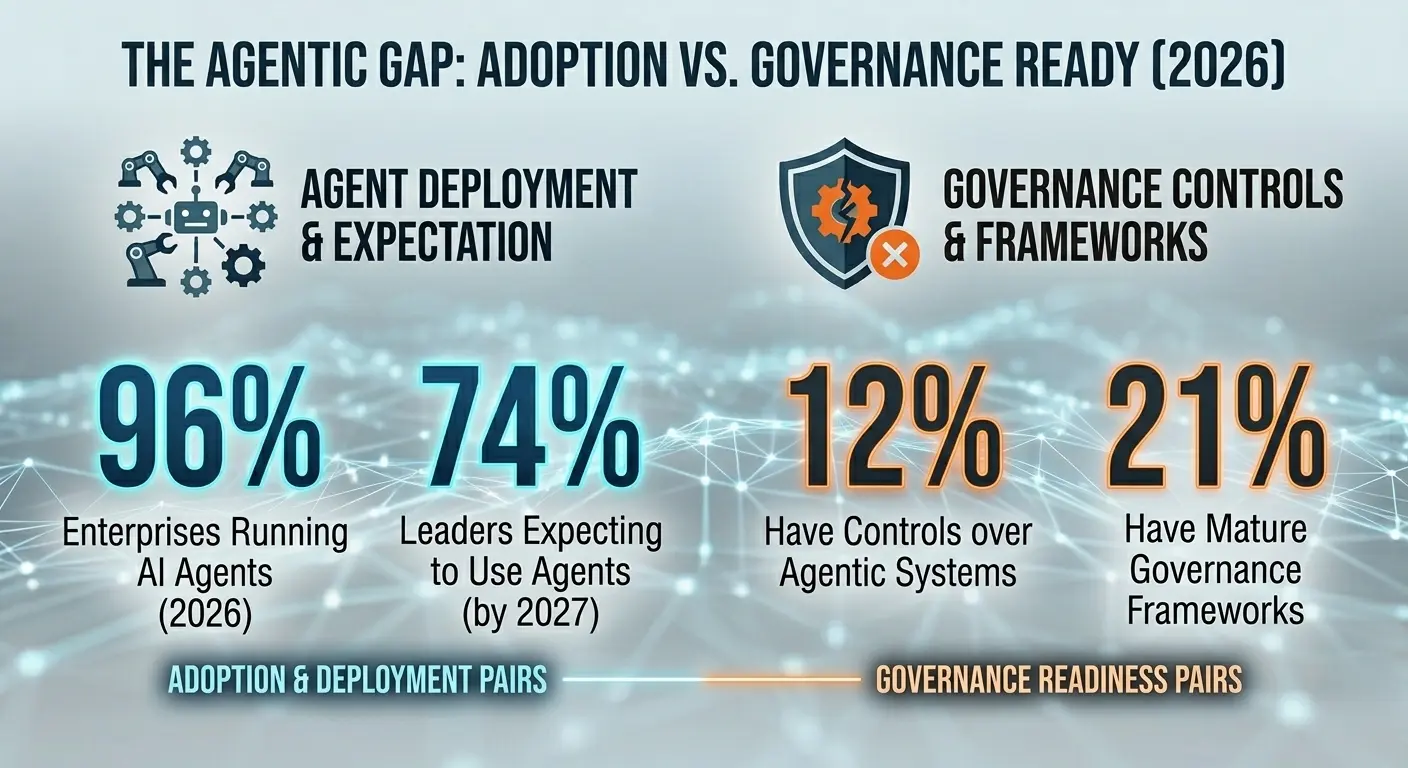
Agentic AI systems do not just respond - they act. They call APIs, modify databases, send communications, trigger workflows, and in some cases spawn sub-agents to complete delegated tasks. The 2026 data tells a story of adoption racing wildly ahead of oversight:
- 96% of enterprises are running AI agents in some form, but only 12% have centralized controls over them.
- 74% of organizations expect to use AI agents by 2027, but only 21% have mature governance frameworks to manage them.
How AI Governance Failures Are Showing Up on X (Twitter) in 2026
The conversation about AI governance has moved from academic papers to real-time public discourse. X (Twitter) has become the fastest signal of enterprise AI failure - the platform where governance breakdowns surface first, before the official post-mortems arrive.
In 2026, several patterns in this public discourse reveal what is actually happening inside organizations that prefer not to announce it:
Boardroom accountability posts from current and former executives describe situations where AI systems caused verifiable harm - discriminatory outcomes, financial errors, compliance violations - and no one inside the organization had a clear mandate to respond. The recurring phrase in these posts is "nobody owned it."
The Three Pillars of a Real AI Governance Framework
A functional AI governance framework in 2026 operates across three distinct layers. Organizations that treat any one of these as optional are building on an incomplete foundation.
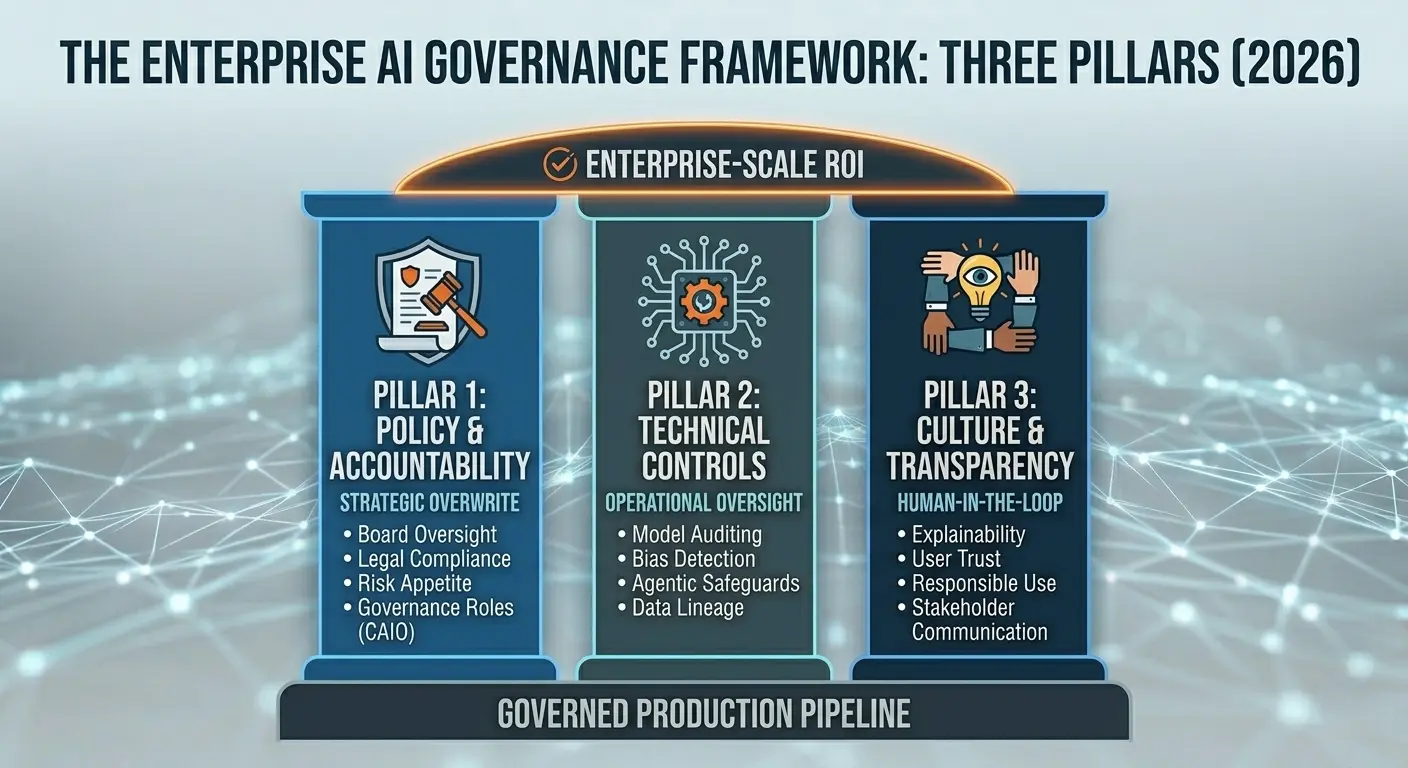
Pillar 1: Policy and Accountability (The "Who Owns This" Layer)
Every AI system deployed in your organization needs a named owner - not a team, not a department, but a person who can be called at 2am when the system behaves unexpectedly. That owner needs escalation authority: the power to pause, modify, or shut down the system without requiring a committee meeting.
Deep Dive: Discover why boards are now holding technical leaders personally accountable in our report: Beyond the Hype: Why CEOs Are Firing CTOs over AI Governance Failures.
Pillar 2: Technical Controls (The "Does It Do What We Think" Layer)
Technical governance is not the same as building a better model. It covers the monitoring and intervention systems that operate around the model:
- Bias detection pipelines that run continuously in production, not just at model evaluation time
- Drift monitoring that alerts when model behavior deviates from its validated baseline
Pillar 3: Culture and Transparency (The "Will People Actually Use the Governance" Layer)
The most underestimated governance pillar. Practitioners in 2026 have identified a counterproductive dynamic: thick governance policies create friction, friction drives shadow AI use, shadow AI creates the exact risks governance was designed to prevent.
The 30% Rule: A Practical Heuristic for Governance Budgets
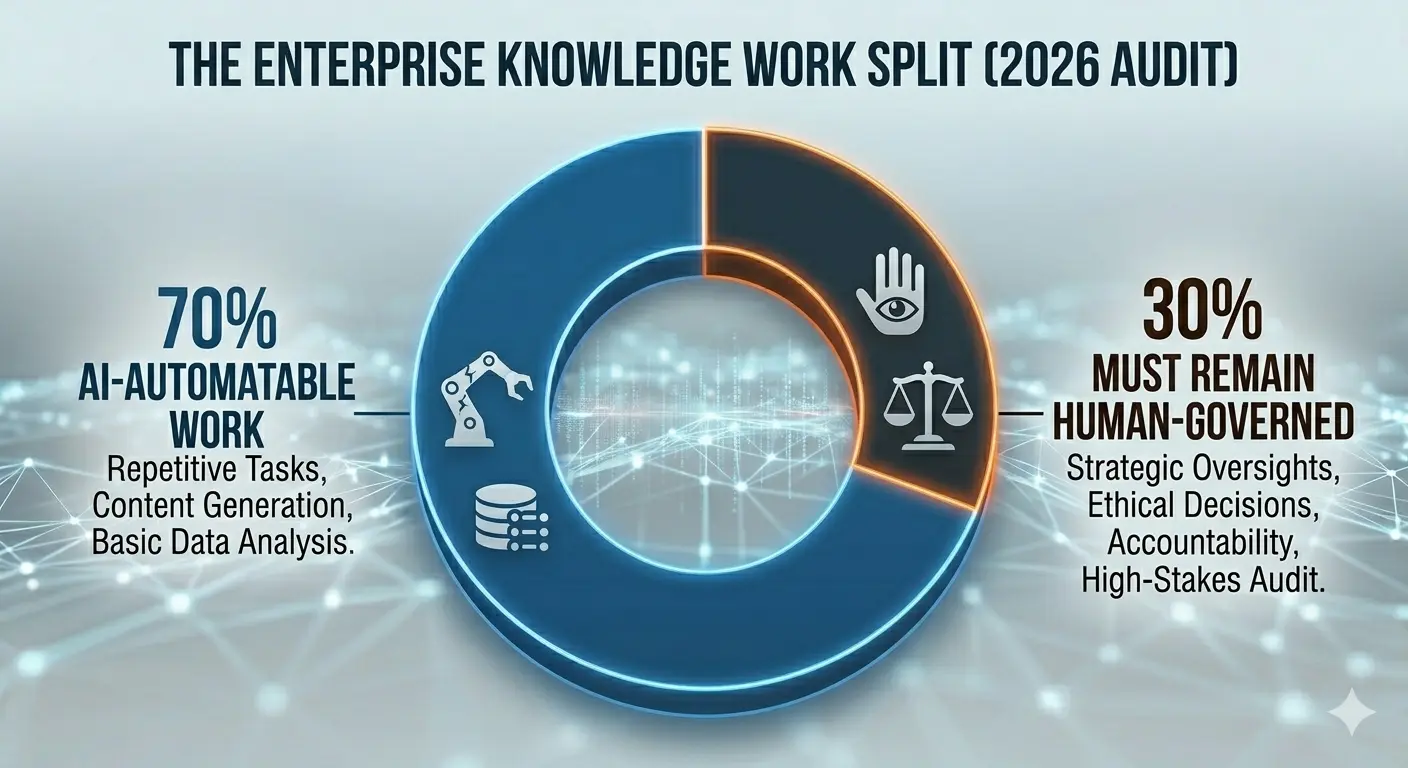
The "30% Rule" has emerged in 2026 as a useful governance heuristic, developed from practitioner analysis by Till Schmid and others. It operates across three dimensions:
What is the 30% rule in AI?
The 30% rule is a strategic heuristic stating that 30% of an AI budget should be dedicated to governance, no more than 30% of a process should be automated without human review, and the final 30% of knowledge work must remain human-governed.
How much should I budget for AI governance?
Practitioners recommend allocating at least 30% of your total AI transformation budget to data quality, monitoring infrastructure, and governance frameworks to ensure long-term ROI and risk mitigation.
What the EU AI Act Means for Your Business Right Now
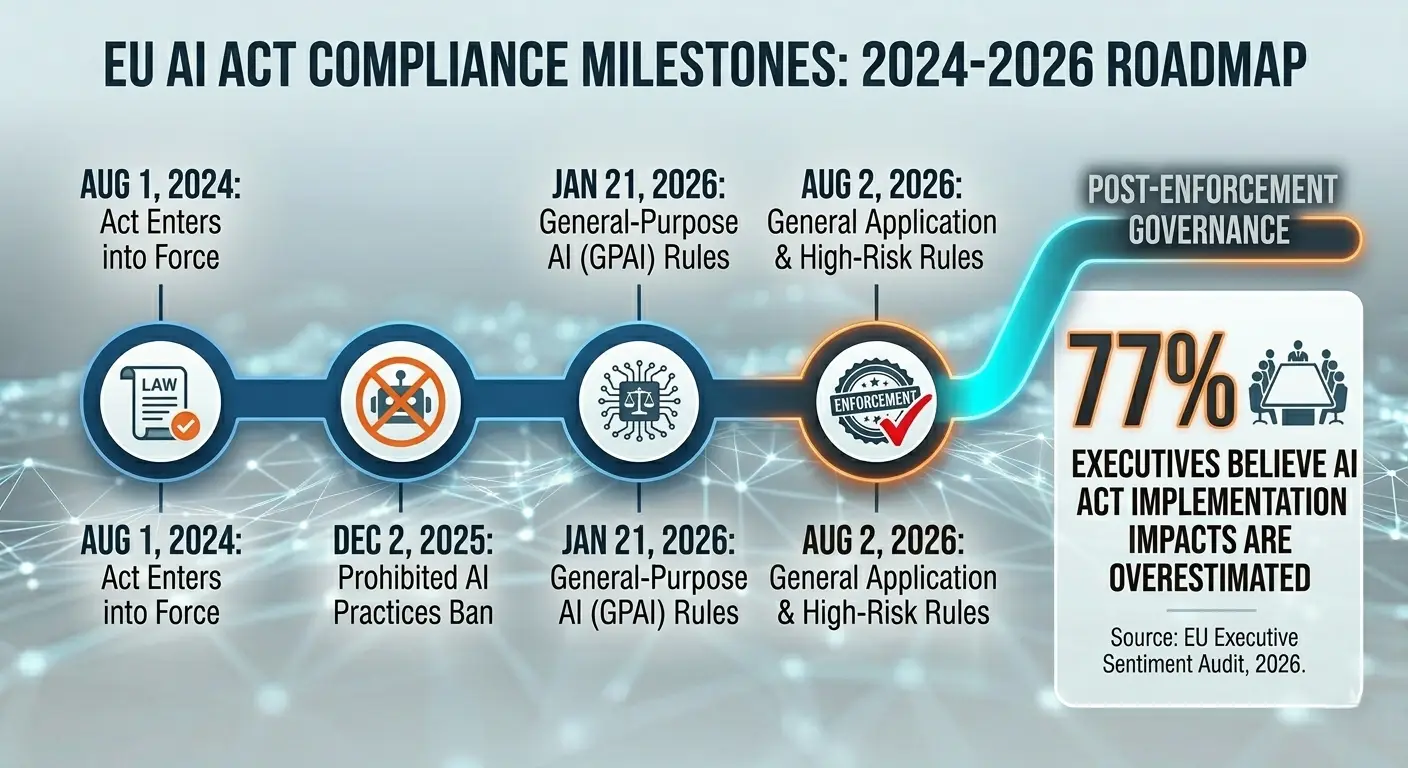
August 2, 2026 is the hard deadline. On that date, the EU AI Act reaches full applicability for high-risk AI systems. For organizations operating in European markets - or using AI systems that touch European data subjects - the obligations are immediate and retroactive. Pre-existing systems are not grandfathered.
Bias Is Not a Technical Problem. It Is a Governance Failure.
The framing of AI bias has shifted decisively in 2026. Regulators under the EU AI Act, India's MeitY framework, and US EEOC AI guidance no longer treat biased AI outcomes as evidence of bad training data. They treat them as evidence of poor governance - a failure of the oversight processes that should have detected, escalated, and corrected the bias before it caused harm.
Your 2026 AI Governance Roadmap: Where to Start
The evidence is clear. The organizations succeeding with AI transformation in 2026 are not the ones with the most advanced models. They are the ones that treated governance as a structural capability, not a compliance formality.
Frequently Asked Questions
What is AI governance and why does it matter in 2026?
AI governance is the complete set of policies, accountability structures, technical controls, and cultural practices that determine how AI systems are built, deployed, monitored, and corrected inside an organization. It matters in 2026 because the majority of AI projects - estimates range from 60% to 95% - are failing not due to technical problems but due to the absence of these structures.
Why is AI transformation considered a problem of governance?
Because the failure points are organizational, not technical. The models work. The infrastructure exists. What is missing is the ownership clarity, escalation design, bias oversight, and decision provenance that allow AI systems to operate reliably at scale. Governance is the missing layer in most AI transformations.
What is the EU AI Act compliance deadline?
August 2, 2026 is the full applicability date for high-risk AI systems. Conformity assessments, transparency obligations, CE marking, and database registration are required. The obligations apply retroactively to pre-existing systems, and non-compliance can result in market exclusion, not only fines.
What is agentic AI governance?
The set of controls that govern autonomous AI agents - systems that act independently by calling APIs, modifying data, and triggering workflows. Agentic governance requires centralized authorization registries, defined operational limits, loop detection controls, and clear kill conditions. As of 2026, only 12% of organizations running AI agents have centralized controls in place.
What is the 30% rule in AI?
The 30% rule is a strategic heuristic stating that at least 30% of an AI budget should be dedicated to governance, no more than 30% of a complex process should be automated without human review, and the final 30% of knowledge work (judgment/ethics) must remain human-governed.