Beyond the Hype: Why CEOs Are Firing CTOs over AI Governance Failures

Beyond the Hype: Why CEOs Are Firing CTOs over AI Governance Failures
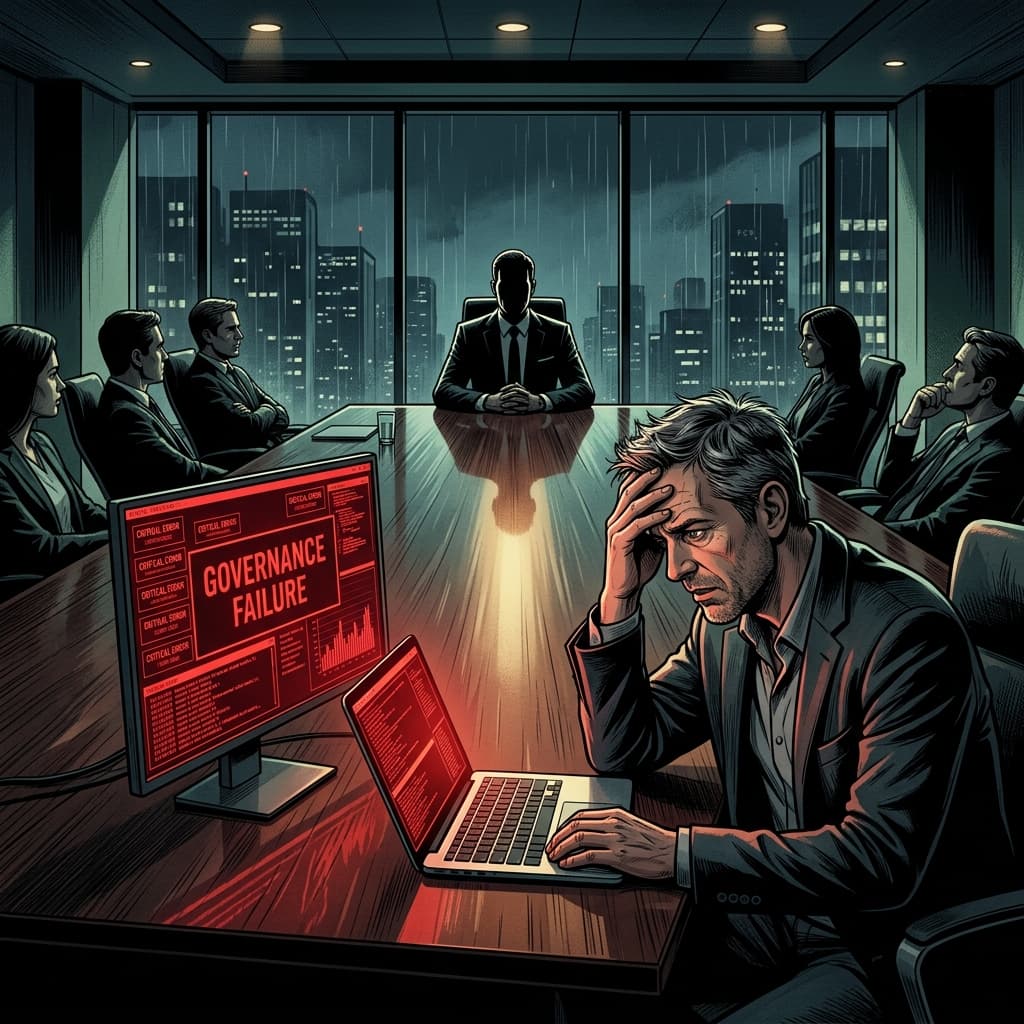
The 2026 Leadership Shift: It is no longer "how fast can we ship AI?" It is "who is accountable when it breaks?" When boards can't find an answer, the CTO is often the first to go.
Table of Contents
- The Leadership Reckoning Nobody Saw Coming
- What an AI Governance Failure Actually Looks Like
- Three Patterns of AI Governance Failure That Ended Careers
- The Proof Gap: 78% of Executives Cannot Pass a Governance Audit
- Why Boards Are Now Personally on the Hook
- The CTO-COO Fault Line
- What Separates the CTOs Who Survived from Those Who Did Not
- The Governance Architecture That Protects Careers
- Frequently Asked Questions
The Leadership Reckoning Nobody Saw Coming
In 2025, companies in the S&P 1500 named 168 new CEOs, the highest total in more than 15 years. The reason cited repeatedly was not poor financial performance or failed acquisitions. It was AI.
The CEOs of Lululemon, Disney, and Target stepped down in early 2026. Adobe CEO Shantanu Narayen and former Walmart CEO Doug McMillon both cited the need for new leadership capable of guiding AI growth and transformation as direct factors in their transitions.
But while the CEO departures made headlines, a more surgical culling was happening in the technical suite. The question defining executive careers in 2026 is not "did you adopt AI?" Everyone did. The question is "can you prove it is governed?"
What an AI Governance Failure Actually Looks Like at the Executive Level
Governance failures do not arrive as dramatic system crashes. They arrive as patterns that accumulate quietly until they become impossible to ignore:
- Unexpected shifts in customer recommendations.
- Spikes in credit anomalies that defy standard logic.
- Supply chain models that seem unusually "confident" but consistently wrong.
- Workforce scheduling systems making decisions no one can fully explain.
Executives often chalked these up to "algorithmic quirks" until boards began to sense something deeper. This is the core of the problem: AI transformation is fundamentally a problem of governance. An "unforeseeable technical failure" can be managed as an incident; a "foreseeable governance failure" is a liability event.
Three Patterns of AI Governance Failure That Ended Careers
The underlying patterns repeat across organizations that have gone through painful leadership transitions:
Pattern 1: The Invisible Footprint
The organization deployed more AI than anyone mapped. Internal teams built tools without approval, and acquisitions brought models nobody documented. When a regulator or board asks "what AI systems are operating and who owns them?", the CTO who cannot answer has already lost.
Pattern 2: The Ownership Vacuum
AI systems were deployed without a named human owner carrying direct accountability. Responsibility was diffused across committees and vendors until no single person had authority to act. As we explored in our AI Governance Pillar Page, accountability vacuums are filled by whoever is most visible—usually the CTO.
Pattern 3: The Regulatory Surprise
The organization assumed existing compliance structures would transfer cleanly to AI. They were wrong. The August 2, 2026 EU AI Act deadline has proven that you cannot outsource accountability. The "we relied on our vendor" defense does not hold in 2026.
The Proof Gap: 78% of Executives Cannot Pass a Governance Audit
Grant Thornton's 2026 AI Impact Survey produced a stark measurement: 78% of business executives lack confidence that they could pass an independent AI governance audit within 90 days.
This "Proof Gap" is not a compliance problem—it's a performance problem. CTOs who close this gap aren't just protecting themselves; they are building the architecture that lets their organizations scale AI with confidence.
Why Boards Are Now Personally on the Hook
Board members are now directly in the accountability chain. BlackRock and Allianz have updated stewardship guidelines, and by the 2026 proxy season, boards must demonstrate AI literacy and documented oversight frameworks.
Failures are no longer just "technical debt"; they are Caremark-style derivative claims and reputational damage events.
The CTO-COO Fault Line Nobody Is Talking About
There is a massive perception gap: CIOs and CTOs are five times more likely than COOs to say the workforce is ready for AI.
More than half of COOs (54%) are concerned about regulatory uncertainty, compared with just 20% of CTOs. Resolving this fault line is now a core CTO responsibility. It requires a structural architecture that addresses operational risk before it becomes an incident.
What Separates the CTOs Who Survived from Those Who Did Not
CTOs who maintained their positions shared these governance capabilities:
- They built a live AI inventory before they were asked. They knew they couldn't govern what they couldn't see.
- They assigned named owners to every system. Individuals, not committees.
- They embedded governance into the workflow. They made the compliant path the easiest path.
- They stopped the "black box" defense. If a system was too opaque to be governed, it was too opaque to be deployed.
The Governance Architecture That Protects Careers and Companies
The surviving organizations share a recognizable pattern:
- A live AI system registry: Documented with owner, risk classification, and monitoring status.
- Decision provenance infrastructure: The ability to reconstruct the reasoning chain for any AI-driven decision.
- Escalation paths with actual authority: Named humans with the power to kill a system without committee approval.
- Continuous bias monitoring: A production function, not a one-time pre-deployment evaluation.
This is what we call the foundational architecture for the 2026 AI shift.
Frequently Asked Questions
Why are CTOs specifically at risk from AI governance failures?
Because AI failures are structural, not just regulatory. The CTO owns the architecture. When that architecture lacks accountability chains and monitoring, it traces back to a systems design decision, making it a CTO responsibility.
What is the "proof gap" in AI governance?
It's the gap between what organizations claim and what they can demonstrate to an auditor. In 2026, 78% of executives couldn't pass an audit within 90 days. Closing this gap is the difference between surviving a regulatory inquiry and losing a career.
Can a CTO delegate AI governance to a Chief AI Officer (CAIO)?
Execution can be delegated, but accountability cannot. The CTO who created the conditions in which the CAIO operates retains the structural accountability for the outcomes.
This article is part of our series on structural intelligence. For the foundational framework, read our pillar page: AI Transformation is a Problem of Governance.